




Health & Education
We all want the best care possible for our horses. The Heath & Education section covers both Learning Institutions, Organizations as well as many sources for equine assistance including Veterinarians and Farriers.
For those who want a to formally study horses, the Education section includes College Riding, Equine Studies, and Veterinary Schools. Learn about the wide variety of horses in the Horse Breeds section. Supplements and Treatments Therapy are also included in the section.
Everyone can learn from Fine Art and there are some specialty Museums that might surprise you.
Horses as a therapy partner enrich the lives of the disabled. These facilities are listed in our Therapeutic Riding section. To help children and young adults build confidence and grow emotionally, please see the resources available on the Youth Outreach page.
Looking for a place to keep your horse? You can find it in the Horse Boarding section. Traveling? Find a Shipping company or Horse Sitting service if your horse is staying home!
Want to stay up to date with the latest training clinics or professional conferences? Take a look at our Calendar of Events for Health & Education for the dates and locations of upcoming events.
Do we need to add more? Please use the useful feedback link and let us know!
By Juliet M. Getty, Ph.D.
Beet pulp is the pulp of the sugar beet plant, after the sugar has been removed. So the remaining pulp has virtually no sugar. If molasses is added to improve taste, it is low — less than 3% -- that’s approximately ½ cup of sugar in 10 lbs of beet pulp. And you likely wouldn’t feed anywhere near that amount — it takes 2 quarts of beet pulp to equal 1 lb, so 10 lbs would be 20 quarts!
Beet pulp contains 15% fiber, a little less than the 18% fiber typically required to be considered a forage. But it is still a good source of fiber because this 15% is mostly digestible fiber, meaning it is easily digested by the bacterial flora in your horse’s hindgut. And better yet, it doesn’t get digested in the foregut, so blood glucose levels are not affected. So it has a low glycemic index and minimal insulin response, making it a wonderful feed for any horse that needs to reduce starch and sugar intake. And from a digestible energy (calories) perspective, beet pulp is right up there with the big cereal grains. It supplies 1.3 Mcal/lb compared to oats, with 1.5 Mcal/lb.
It comes in two forms — pellets and shreds. Pellets must be soaked to prevent choke. The shredded form can be fed dry, but soaking will ease your mind since it is very dry and some horses labor over chewing it. Soaking time depends on the water temperature. If you have hot water in your barn, the beet pulp shreds will soak this up almost immediately; pellets will require approximately 30 minutes. Cold water will take longer to soak up. But do not soak beet pulp overnight; bacteria and mold will accumulate.
Beet pulp is a good source of calcium, though not as high as alfalfa. Don’t worry about feeding too much calcium when offering beet pulp because much of the calcium is bound to oxalates, making it less absorbed. For the same reason, you cannot rely on beet pulp calcium to offset a high phosphorus intake (from bran, for example).
Finally, beet pulp makes an excellent carrier for supplements or medications. If your horse is on hay or pasture, and you want to add a vitamin/mineral supplement, you need to add it to something. The supplement will mix in well with soaked beet pulp, and you won’t find it sifting to the bottom of the feed bucket. One more thing — be sure to add your supplement once you’re ready to feed; don’t soak it since prolonged water contact will destroy most vitamins.
After all these good aspects, there is one thing that you need to be aware of... the vast majority of beets grown in the US are genetically modified to withstand being sprayed with Roundup (Monsanto). This herbicide adds glyphosate to your horse's body and may have significant health consequences.* To avoid this, choose a non-GMO source of beet pulp since Roundup is not generally sprayed on this type of crop. Consider Speedi-Beet by Emerald Valley Equine.
This article originally appeared on Getty Equine Nutrition and is published here with permission.
Find more informative articles in our section on Health & Education. While you're here, take a look at our Curated Amazon Store.
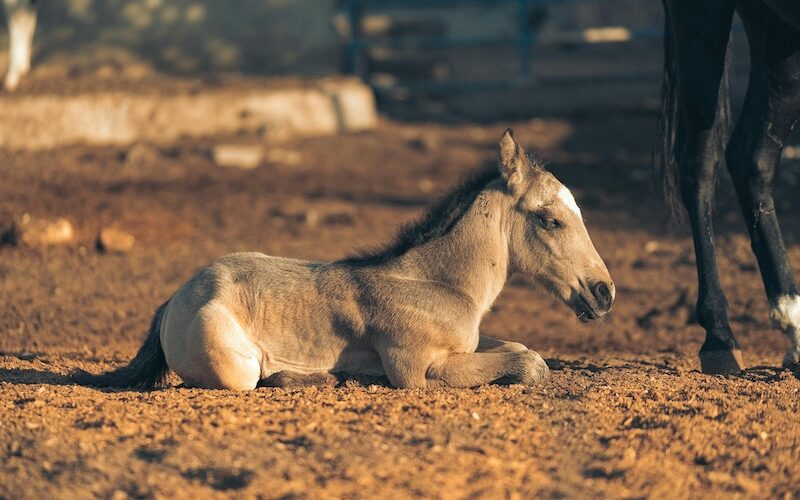
by Kristin Pitzer
The birth of a long-awaited foal is a special time for any breeder, but it can also be an occasion fraught with anxiety. Even if you do everything right — feed your mare correctly, keep her in good shape, vaccinate her on schedule — and are present during the birth, unexpected things can still happen.
In some cases, a foal may seem normal when it’s born, but then fail to meet milestones such as standing, nursing and following the mare around. This is often the case in foals with neonatal maladjustment syndrome (NMS), also known as “dummy foal syndrome,” hypoxic ischemic encephalopathy or perinatal asphyxia. Quarter Horse News spoke with Dr. Rudy Madrigal at Equine Sports Medicine and Surgery in Weatherford, Texas, to get more information on what causes dummy foals and how to proceed if you think your foal might be affected.
Elevated Levels of Neurosteroids May Cause NMS
NMS was originally believed to be caused by low oxygen levels during birth, resulting in damage to the foal’s central nervous system. New evidence suggests that, instead, it may result from the failure of placental hormones, or neurosteroids, to decrease after birth, keeping the foal in a sedated state. Signs of NMS include the foal’s inability to find and suckle on the udder, as well as a lack of interest in following the mare after standing. Foals can develop symptoms within minutes after birth, or it may take up to 48 hours to see anything abnormal.
“Foals show a variety of neurologic signs — decreased affinity for the mare, not nursing, aimlessly wandering, weak to absent suckle reflex, depressed, respiratory changes and seizures,” Madrigal said. “It is seen in approximately 1 to 2% of births, with no breed or discipline predilection.”
Foals that are improperly positioned before birth and require assistance to pass through the birth canal; foals that experience placental separation, known as red bag deliveries, or placentitis, which is infection of the placenta; c-section deliveries; fescue toxicity; and other conditions may all predispose a foal to NMS.
Supportive Care Is Essential to Recovery
Once signs develop and an NMS diagnosis is confirmed, foals must be treated, or else they can develop secondary issues. The most common of these is sepsis, which can lead to death.
“Treatment in these foals is largely supportive, with IV fluids, oxygen supplementation with respiratory support, IV antibiotics, nutritional support, antioxidant, anti-seizure medications and immunity support,” Madrigal said.
Treatment is grueling and can be costly. Foals may need to be tube-fed, and those experiencing seizures might need to be placed in a padded environment to protect them from injury. Some foals can recover in a couple of days, but others may need supportive care for more than a week. All that work can pay off, though — the average survival rate is 85%, and most of those foals can go on to live normal lives and even perform. Those that do not have an infection or limb paralysis have a better outlook.
The Madigan Squeeze Technique Can Be Life-Saving for Some Foals
Depending on the foal, a technique called the Madigan Squeeze Technique could be useful in correcting NMS. Named after its developer, Dr. John Madigan, the technique was developed to create pressure that mimics traveling through the birth canal. Since rapid delivery during birth is suspected to be a cause of NMS, and dummy foals behave as though they are asleep, it is believed that applying pressure to the foal signals its transition from sleeping in the womb to wakefulness.
According to the UC Davis Center for Equine Health, the Madigan Squeeze Technique works by applying pressure to the ribs with ropes looped around the ribcage for 20 minutes, the normal time it takes to travel through the birth canal. Full instructions can be found here; however, this procedure should only be performed by a veterinarian or under their direct supervision. Madrigal cautioned that not every foal is a candidate for the procedure.
“Madigan Squeeze Technique is only shown to work on foals with elevated levels of neurosteroids,” Madrigal said. “This should be used with caution, as other causes can mimic dummy foal, and this can lead to late referral and intervention.”
Don’t Mistake Other Conditions for NMS
The symptoms seen in dummy foals can also be indicative of other conditions, so it’s always best to have your veterinarian involved if you suspect NMS. Other causes of decreased nursing and lethargy include sepsis, aspiration pneumonia, ruptured bladder, fractured ribs and true hypoxic state, a condition where the body’s tissues are receiving an insufficient supply of oxygen and can’t maintain normal physiological function.
The earlier your veterinarian can intervene in these issues, the better the prognosis for your foal, Madrigal said. Therefore, it’s important to not jump to an NMS diagnosis without ruling other problems out.
Research on Dummy Foals Is Helping Human Medicine
NMS is linked to autism in humans — the behavioral abnormalities seen in foals, such as detachment, are similar to symptoms children with autism express. Researchers in veterinary and human medicine are working together to investigate whether increased levels of neurosteroids could contribute to both disorders.
This article originally appeared on American Quarter Horse News and is published here with permission.
There are more informative and entertaining articles in our section on Health & Education. While you're here be sure to check out our Curated Amazon Store.
- The Role of Nutrition in Managing Muscle Disorders
- Secrets of Successful Riding Instructors
- Horse Veterinarians in Alabama
- Horse Veterinarians in Alaska
- Horse Veterinarians in Arizona
- Horse Vet in Arkansas
- Horse Veterinarians in California
- Horse Veterinarians in Colorado
- Horse Veterinarians in Connecticut
- Horse Veterinarians in Delaware
- Horse Veterinarians in Florida
- Horse Veterinarians in Georgia
- Horse Veterinarians in Idaho
- Horse Veterinarians in Illinois
- Horse Veterinarians in Indiana
- Horse Veterinarians in Iowa
- Horse Veterinarians in Kansas
- Horse Veterinarians in Kentucky
- Horse Veterinarians in Louisiana
- Horse Veterinarians in Maine