





Health & Education
We all want the best care possible for our horses. The Heath & Education section covers both Learning Institutions, Organizations as well as many sources for equine assistance including Veterinarians and Farriers.
For those who want a to formally study horses, the Education section includes College Riding, Equine Studies, and Veterinary Schools. Learn about the wide variety of horses in the Horse Breeds section. Supplements and Treatments Therapy are also included in the section.
Everyone can learn from Fine Art and there are some specialty Museums that might surprise you.
Horses as a therapy partner enrich the lives of the disabled. These facilities are listed in our Therapeutic Riding section. To help children and young adults build confidence and grow emotionally, please see the resources available on the Youth Outreach page.
Looking for a place to keep your horse? You can find it in the Horse Boarding section. Traveling? Find a Shipping company or Horse Sitting service if your horse is staying home!
Want to stay up to date with the latest training clinics or professional conferences? Take a look at our Calendar of Events for Health & Education for the dates and locations of upcoming events.
Do we need to add more? Please use the useful feedback link and let us know!
By Jochen Schleese, CMS, CSFT, CEE
When I first started teaching my wife, Sabine, how to ride, I couldn’t understand why she kept complaining that the saddle hurt her there. I would get on the same saddle and have absolutely no problem. She, on the other hand, had difficulty keeping correct positioning with her legs back, back straight, and shoulders back. Then when we I started building saddles in Canada, Sabine was my guinea pig, but because she didn’t want to hurt my feelings, she never admitted that the saddles I was making (for female clients) weren’t really comfortable for her.
When a well-known judge and rider confided in me that she was literally “rubbed raw” and felt pulled apart, a light bulb went off in my head. I conferred with a gynecologist and began to investigate the differences in male and female anatomy, starting with pelvic structure, and then including hip articulation, muscles, and skeleton. I learned that the differences between men and women were extremely significant when considering saddle design. We then started using a plaster cast method, which served as incredible visual aids to make our full custom saddles.
Since then, we have refined our designs and are now known as the “Female Saddle Specialist,” a niche which becomes even more fitting when you consider that the demographics of our industry have shifted significantly over the past 50 years or so to become predominantly female.
With this shift in demographics, why haven’t more saddle manufacturers taken this into consideration when making saddles? Many still build saddles the way they have been made for decades, and some women still dismiss the idea of needing a saddle built specifically for their conformation. Many riders have simply learned to deal with the discomfort and ride well enough to make these saddles work, but it’s not ideal.
I have worked closely with a very qualified equestrian medical expert in our industry, James Warson, MD, who wrote the book, The Rider’s Pain Free Back. I have incorporated many of his findings into my own book.
So let’s consider the various anatomical differences and how they apply to saddle fit for women.
Width of the seat bones (birthing channel): This determines how wide the saddle seat needs to be; in many of the saddles made for men, a woman will actually find herself sitting on the seat seam, which is irritating to say the least.
Spinal column: Riders need to be able to use the four natural curves of the vertebral column as natural shock absorbers. If a female rider leans back or hunches forward because the saddle isn’t right for her, her spine will take the brunt of the impact and result in back pain issues, which could result in slipped discs.
Pelvic balance and pubic symphysis: The male pelvis can balance on its seat bones as on a bipod; the female pelvis needs to use her pubic symphysis as well as her seat bones, like a tripod. For women, this means there is another area of friction at the pommel area, which can result in pain. To compensate and avoid pain, the rider in pain might collapse at the hip, which then causes the leg to shoot forward, placing the rider in the chair seat position.
Hip joints: The male hip joints are articulated differently, which allows the legs to hang straight down, whereas women’s legs are naturally angled outwards. This results in the female rider feeling pulled apart if the twist, the area of the saddle tree that we feel between our upper inner thighs, is too wide.
Upper leg musculature: Because of the structure of the quads and hamstrings as indicated in the picture, the woman needs to have a narrower twist (as a rule).
Gluteus maximus (butt cheeks): The female’s glutes are much higher up than a man’s, which indicates the need for additional support in the seat at the cantle area to prevent her from collapsing to the back.
If all of these points are taken into consideration when fitting a saddle, a woman can use the properly fitted saddle to help her ride in proper position and balance. She can now concentrate on her ride rather than fighting her saddle for proper position.
For a man, riding in a saddle that is uncomfortable for him (especially at the pommel area because of too much padding at the seat) could result in restricted blood flow in the sensitive perineal area. This could lead to erectile dysfunction, impotence, or other physical problems.
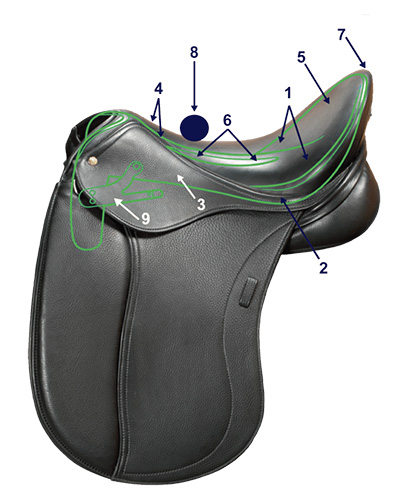
These are the points of reference every rider should ensure are correct for his or her body, regardless if they are male or female:
- Width of the seat to support the seat bones
- Skirt attachment with flat seaming to avoid pressure at the back of the upper inner thigh
- Saddle twist appropriate for male or female to accommodate upper leg musculature
- Angle of the pommel to avoid hitting the pubic symphysis (waist seaming width)
- Seat foam (mattress) to support the gluteus muscles
- Flattest part of the saddle, or the supporting area, where the majority of weight is carried; needs special attention to avoid pressure on the crotch area
- Cantle angle to provide necessary support
- Saddle balance (many women prefer forward balance)
- Stirrup bar position to accommodate the upper leg length to lower leg length ratio (most women will require extended stirrup bars since their upper legs are longer than their lower legs); if this is not considered and fitted properly to the rider, the leg will naturally swing forward
In summary, the saddle should allow the rider to sit as closely to the horse as possible while allowing the positive and balanced interaction of the vertical spine of the rider and the horizontal spine of the horse. Riding shouldn’t hurt, and this goes for both the rider and the horse If the rider isn’t comfortable, this will translate down to the horse, and he will never perform to the best of his ability. So us riders owe it to ourselves and to our horses to ride in a saddle suited to our body. As the saying goes, “You are worth it!”
Author Bio]
Jochen Schleese, author of Suffering in Silence: The Saddle Fit Link to Physcial and Psychological Trauma in Horses, is a Certified Master Saddler from Passier He operates a saddlery training facility in Ontario, Canada, and provides diagnostic saddle fit analysis and fitting services across North America, especially for women. SaddlesforWomen.com
This article originally appeared on Certified Horsemanship Association and is published here with permission.
There a more informative articles in our section on Health & Education. Don't forget to take a look at our Curated Amazon Store.
By Zoe Gillen and Heidi Lykins, Kentucky Equine Research Interns
In research settings, a standardized exercise test (SET) is a useful tool to assess a horse’s fitness. The test requires the horse to cycle through a succession of gaits using a standard protocol consisting of warm-up, exercise, and cool-down while wearing a fitness monitor. The test has been an incredible asset in many studies conducted at Kentucky Equine Research over the last four decades.
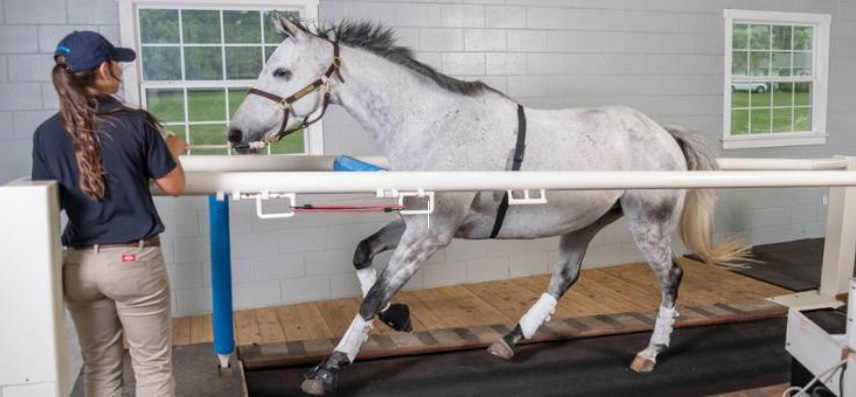
Researchers commonly use SETs to determine the effect of certain treatments or training methods on fitness and recovery. In research scenarios, SETs are usually carried out on a high-speed treadmill, as this enables exercise conditions, such as surface, incline, and speed, to be controlled.
During these tests, exercise intensity and duration are usually increased above the normal training levels, reaching speeds of 12 m/s (27 mph) and inclines up to 5°. This pushes the horse above the lower anaerobic threshold (160 bpm) and can result in significant increases in muscle temperature. The incline allows for both a higher intensity and duration of exercise without the need to increase speed. Exercising on the treadmill is especially beneficial in research as it allows us to control for confounding variables.
This is an example of an 18-minute SET used in a recent study with fit horses, in which researchers observed increases in muscle temperature up to 42° C.
1-min walk (1.6 m/s; 0° incline)
2-min walk (1.6 m/s; 3° incline)
2-min trot (4 m/s; 3° incline)
2-min canter (6 m/s; 3° incline)
3-min canter (6 m/s; 5° incline)
3-min fast canter (8 m/s; 5° incline)
2-min trot (4 m/s; 5° incline)
1-min trot (4 m/s; 3° incline)
1-min walk (1.6 m/s; 3° incline)
1 min walk (1.6 m/s; 0° incline)
Heart rate monitors are commonly used to determine fitness. A lower heart rate at any given speed indicates greater fitness. Another heart rate value commonly used is the velocity at which the horse’s heart rate reaches 200 beats per minute (V200). A horse with a higher V200 is considered more fit. At Kentucky Equine Research, heart rates are collected via smartphone apps that connect to a Bluetooth heart rate monitor, which is situated on a surcingle worn by the horse during exercise.
In addition, muscle temperatures are collected by scanning microchips implanted in the left middle gluteal and pectoral muscles using microchip readers. These muscles are specifically monitored as the middle gluteal muscle contributes significantly to forward locomotion during exercise, and the pectoral muscle is directly correlated with core body temperature.
Blood lactate is another fitness indicator used in research, with lower blood lactate levels translating to improved aerobic capacity and therefore greater fitness. These data can help researchers understand the level of fitness, observe recovery after exercise, and monitor progression over time to ensure effectiveness of training. To record the abundance of data from SETs, the researchers at Kentucky Equine Research created a data collection sheet, shown here with example data.
This article was written by Zoe Gillen and Heidi Lykins, year-long interns at Kentucky Equine Research. As part of the intern program, participants are asked to contribute to Equinews occasionally. Learn more about the internship program.
Read more: Use of Standardized Exercise Tests in Equine Research
- Helping all horses live healthier lives
- 5 Tips For Keeping Aged Horses Fit To Compete
- Fruits are Fabulous, even for Insulin Resistant Horses!
- 12 Tips for Being a Good Member of Your Boarding Barn - an excerpt from "Newcomer to the Horse World"
- $10,000 Equestrian Merit Scholarship
- Non-GMO is NOT Necessarily Safe
- Consider Beet Pulp Instead of Oats
- Five Tips About Dummy Foals
- The Role of Nutrition in Managing Muscle Disorders
- Secrets of Successful Riding Instructors
- Horse Veterinarians in Alabama
- Horse Veterinarians in Alaska
- Horse Veterinarians in Arizona
- Horse Vet in Arkansas
- Horse Veterinarians in California
- Horse Veterinarians in Colorado
- Horse Veterinarians in Connecticut
- Horse Veterinarians in Delaware
- Horse Veterinarians in Florida
- Horse Veterinarians in Georgia