




Health & Education
We all want the best care possible for our horses. The Heath & Education section covers both Learning Institutions, Organizations as well as many sources for equine assistance including Veterinarians and Farriers.
For those who want a to formally study horses, the Education section includes College Riding, Equine Studies, and Veterinary Schools. Learn about the wide variety of horses in the Horse Breeds section. Supplements and Treatments Therapy are also included in the section.
Everyone can learn from Fine Art and there are some specialty Museums that might surprise you.
Horses as a therapy partner enrich the lives of the disabled. These facilities are listed in our Therapeutic Riding section. To help children and young adults build confidence and grow emotionally, please see the resources available on the Youth Outreach page.
Looking for a place to keep your horse? You can find it in the Horse Boarding section. Traveling? Find a Shipping company or Horse Sitting service if your horse is staying home!
Want to stay up to date with the latest training clinics or professional conferences? Take a look at our Calendar of Events for Health & Education for the dates and locations of upcoming events.
Do we need to add more? Please use the useful feedback link and let us know!
By Kentucky Equine Research Staff
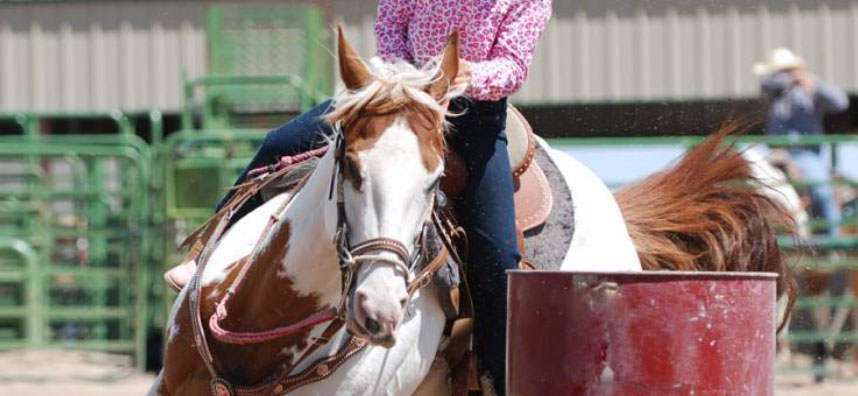
Competitive horses often present to veterinarians with concerns about upper respiratory noise and poor performance. Researchers determined the prevalence of upper airway obstruction by retroactively reviewing medical records of barrel racing horses subjected to overground endoscopy. Upper airway obstruction was common, and over half of those horses were diagnosed with multiple causes of obstruction.
Upper airway obstructions involve structures located in the region of the soft palate and larynx at the back of the throat and include conditions such as:
- Pharyngeal lymphoid hyperplasia;
- Nasopharyngeal collapse;
- Palatal instability;
- Intermittent dorsal displacement of the soft palate;
- Medial deviation of the aryepiglottic fold;
- Recurrent laryngeal neuropathy;
- Vocal fold collapse;
- Ventromedial luxation of the apex of the corniculate process of the arytenoid; and
- Cricotracheal ligament collapse.
“Any of these conditions can have detrimental effects on ventilation and gas exchange, resulting in poor performance,” said Catherine Whitehouse, M.S., of Kentucky Equine Research.
Barrel racing is an anaerobic event that involves sprinting through a cloverleaf pattern at high speed, typically in less than twenty seconds. According to veterinary experts, barrel racing horses are frequently referred for airway evaluations with complaints of roaring and gurgling.*
To improve their understanding of upper airway abnormalities in barrel racing horses, the researchers reviewed the videos obtained during overground endoscopy. This procedure is performed by placing a portable endoscope into the airways of horses and then evaluating the upper airway structures during rest and exercise. In total, 164 Quarter Horses involved in barrel racing underwent overground endoscopy.
No abnormalities were identified in 15% of the evaluated horses during exercise, which means most of the horses were diagnosed with upper airway obstruction. Over half of the horses with abnormalities (56%) had more than one upper airway obstruction, with a total of 279 observed obstructions during exercise. In the 140 horses with upper airway obstructions, the most common abnormalities were nasopharyngeal collapse (49%), pharyngeal instability (42%), and intermittent dorsal displacement of the soft palate (39%). This means that abnormalities of the soft palate and pharyngeal walls occurred more commonly than those involving the larynx.
While airway obstructions are traditionally believed to occur at high speed, the upper airway obstructions noted in this review showed that 55% occurred at low-speed, low-intensity work rather than during the high-speed, high-intensity portion of the exam (only 22%). Specifically, intermittent dorsal displacement of the soft palate was 19 times more prevalent during low-speed exercise. Some horses experienced upper airway obstruction during both low- and high-speed exercise.
“The researchers noted that finding more upper airway obstructions during low-speed, low-intensity exercise was unexpected. They suggested that dynamic upper airway obstructions are not simply due to extreme airway pressures experienced during high-speed exercise or muscle weakness. They proposed it could instead be due to muscular tension or increased contraction of the upper airway secondary to situational stressors or an anticipatory effect of exercise,” explained Whitehouse.
When abnormalities were observed during high-speed exercise, it was primarily during the final straight-line sprint to the finish rather than when turning around the barrels.
“The final sprint is when airway pressure changes are likely the greatest. Also, airway muscle fatigue may be a contributing factor at this point in the competition,” Whitehouse added.
Finding a high prevalence of dorsal displacement of the soft palate brings to light a recent study suggesting that upper airway abnormalities could be a result of asthma. That study suggested looking for evidence of equine asthma rather than focusing on the soft palate exclusively when faced with horses presenting for upper respiratory noise or poor performance.**
For equine asthma, allergen avoidance and using medications such as bronchodilators and corticosteroid anti-inflammatory drugs in conjunction with high-quality marine-derived omega-3 supplement are the treatments of choice based on the most recent guidelines.***
“EO-3 and other antioxidant products developed by Kentucky Equine Research are recommended for horses exhibiting poor performance. Providing these nutrients can help reduce the negative impact of oxidative stress created by intense exercise and demanding competition schedules. Consider adding EO-3, Nano-E, and Nano-Q10 to your feeding program to support health and performance,” Whitehouse recommended.
Reprinted courtesy of Kentucky Equine Research. Kentucky Equine Research is an international equine nutrition, research, and consultation company serving horse owners and the feed industry. Our goals are to advance the industry's knowledge of equine nutrition and exercise physiology, apply that knowledge to produce healthier, more athletic horses, and support the nutritional care of all horses throughout their lives. Learn more at KER.com.
There a more informative articles in our section on Health & Education.
*Massie, S.L., and R. Léguillette. 2023. Upper airway endoscopy in exercising horses: Findings in 164 barrel racing horses with respiratory clinical signs and/or poor performance. Veterinary Journal 300-302:106038.
**Joó, K., Á. Povázsai, Z. Nyerges-Bohák, O. Szenci, and O. Kutasi. 2021. Asthmatic disease as an underlying cause of dorsal displacement of the soft palate in horses. Journal of Equine Veterinary Science 96:103308.
***Couëtil, L.L., J.M. Cardwell, V. Gerber, J.-P. Lavoie, R. Leguillette, and E.A. Richard. 2016. Inflammatory airway disease of horses—Revised consensus statement. Journal of Veterinary Internal Medicine 30(2):503-515.
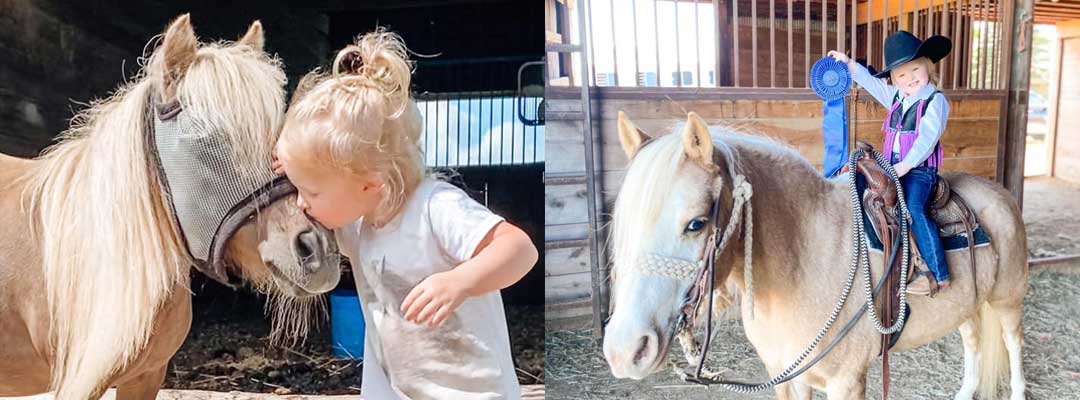
The daughter of an equestrian and team roper -- and granddaughter of a 4-H horsemanship leader and farrier -- 3-year-old Payton was simply born into the horse world. Smiling ear-to-ear pictured upon her pony, Taco, with a blue ribbon on his bridle, it’s easy to see the family passion runs deep. She’s a horse girl through and through.
For parents with children who dream of getting a horse one day, or maybe already have horses and would like to help start their kids off on the right hoof with horseback riding, where does one begin?
Ashley Wheeler -- ranch rider, former collegiate equestrian, wife and mom of Payton -- explains three key factors that helped to encourage young Payton’s love for and involvement with horses.
1: It’s her decision.
“She loves her pony, Taco -- a little Palomino pony with stocking legs and blue eyes. She goes to horse shows with us, and she goes out with us when my husband ropes. She’s playing in the arena when we ride.
We make sure that it is her choice and her decision to be involved in horses. Of course, my husband and I want her to be involved in horses, but we know that it’s her choice, and it has to be a decision that she makes.
If she wants to ride when she gets home every day, she wants to. But if she says she doesn't want to ride today, then we're not going to force it. So, anytime she shows the interest, we support it fully, but we're never going to say, ‘Hey, we have to ride.’
I've seen kids that have been forced to ride, and as soon as they can stop, they do. We want to encourage them to be involved, whether it's showing or barrels -- whatever -- but it needs to be their idea. And while that's kind of frustrating, at the same time, it is awesome when you see her be excited about it.”
2: Horse care is a priority.
“We have a similar approach to my dad's, when I was a little kid. ‘We have these animals, and it's our job to take care of them.’ That's definitely something that was important to my parents [both horsemen] when growing up. Payton continues to get more and more involved in the horses as she gets older. She’s even started helping me clean stalls now. She understands that if it's hot outside, we need to go check the water for the horses, or that Taco is hungry, and we need to go feed him breakfast.”
3: She has a kid-safe pony or horse.
“I see a lot of people wanting to get a young horse for their young kids, so they can ‘grow together.’ But I think there is nothing better than a ‘been there, done that’ safe, older horse for a kid. I believe these horses know it’s a reward for being good for their earlier parts in life. They get to be brushed on and have bows put into their mane.”
Find everything needed to support your young rider’s love for horses, including tack, horse riding helmets and more at ValleyVet.com.
- Highlining with Fred Bruce and Stan Loewen
- Double Lunging the Horse with Mitzi Summers (10:53)
- Music Helps Horses Better Respond to Performance Demands
- What to Expect When Sedating a Horse
- Benefits of Beet Pulp for Horses
- Monty Roberts - Cinder Part 2 The Value of Force Free Training (2:19)
- Monty Roberts - Cinder Part 1: Join Up with a Wild Horse (2:04)
- Inside the In Vitro Fertilization Lab at Rood & Riddle with Dr Charlie Scoggin & Dr Maria Schnobrich (37:25)
- The Making of a Dressage Trainer
- Topline Loss - How Nutrition Can Help
- New Tool Recognizes Pain in Horses with Osteoarthritis
- My Horse is Gaining Weight on Free-Choice Forage! Why Isn't it Working?
- 6 Must-haves For Your Next Horse Show
- Inside the Recipient Mare Herd from the Rood & Riddle Reproduction Center with Crystal Howard" (24:28)
- Breeding for the Next Champion: 6 Important Considerations for Broodmares
- Empty Fields Everywhere Why Movement is So Important
- Hard Tying the Horse to a Rail or Post with Michal Kays (5:37) - Certified Horsemanship Association
- The Icelandic Horse - Quite the Characters!
- 4 Signs of a Happy Horse
- Stallside Podcast - Behind the scenes with the Rood & Riddle Anesthesia and Surgery Technician Team (34:01)