





by Kentucky Equine Research Staff
Horse owners, veterinarians, and researchers can measure a horse’s body temperature in multiple ways. By far the most common method is the use of digital rectal thermometers. While simple to use, these devices may offer inconsistent readings and pose a safety risk to handlers and horses.
Though less common, other ways of recording body temperature include a disposable sensor attached to the underside of the horse’s tail, primarily used for tracking temperatures over long periods, and an infrared thermometer, thought to have a weak correlation to core body temperature and to be easily influenced by external factors.1
At Kentucky Equine Research, caretakers often record body temperature several times daily. For this reason, they rely on percutaneous thermal sensing microchips (PTSMs), which provide faster and more accurate readings than traditional methods.
As their name implies, PTSMs are small devices, no larger than the microchips used for pet identification. They are implanted into specific muscles of the horse. Thirty-three horses across three farms at Kentucky Equine Research have PTSMs placed in a gluteal muscle, with an average muscle depth of 1.81 ± 0.56 cm for the horses residing in Florida at the Kentucky Equine Research Performance Center.
Twelve of the 33 have a second microchip in the pectoral muscle at a muscle depth of 1.42 ± 0.31 cm.2 The gluteal muscles form the large mass over the horse’s croup, while the pectoral muscles lie between the front legs along the chest.
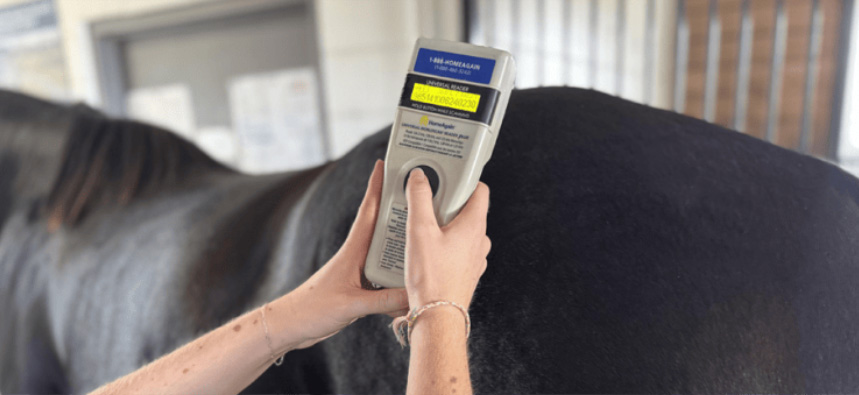
Once implanted, PTSMs can be scanned immediately with a HomeAgain microchip reader, which displays the horse’s temperature instantly on-screen. Users can also link the microchip to a unique identification number for each horse and keep a record of the data using the EquiTrace app.
This process can be repeated as many times as needed, as the microchips have lifelong battery power, and the microchip readers are rechargeable.3
Ease of reading is especially important at Kentucky Equine Research. With PTSMs, researchers can safely track a horse’s body temperature while the horse is exercised on a high-speed treadmill, a feat impossible with traditional rectal thermometers.
The use of PTSMs has greatly influenced the welfare of horses by detecting early signs of unusual changes in body temperature, such as fever or heat stress. This is especially important in horses undergoing strenuous exercise in hot and humid conditions where heat dissipation is difficult.1
Kentucky Equine Research has put this technology to good use during research trials, allowing scientists to better understand the efficacy of different cooling methods after exercise.2
Percutaneous thermal sensing microchips represent a major advancement in equine health monitoring and research.
This article was written by Kelly Dawkins, a year-long intern at Kentucky Equine Research. As part of the intern program, participants are encouraged to contribute to Equinews. Learn more about the internship program.
Reprinted courtesy of Kentucky Equine Research. Kentucky Equine Research is an international equine nutrition, research, and consultation company serving horse owners and the feed industry.
Our goals are to advance the industry's knowledge of equine nutrition and exercise physiology, apply that knowledge to produce healthier, more athletic horses, and support the nutritional care of all horses throughout their lives. Learn more at Kentucky Equine Research.
1Kang, H., R. R. Zsoldos, J. E. Skinner, J. B. Gaughan, V. A. Mellor, and A. Sole-Guitart. 2022b. The use of percutaneous thermal sensing microchips to measure body temperature in horses during and after exercise using three different cool-down methods. Animals 12:1267.
2Pagan, J. D., and R. W. Springer. 2025. Using percutaneous thermal-sensing microchips to assess the efficacy of active versus passive cooling in exercising Thoroughbred horses: An integrative data analysis. Journal of Equine Veterinary Science 148:105538.
3Kang, H., R. R. Zsoldos, S. M. Woldeyohannes, J. B. Gaughan, and A. Sole Guitart. 2020. The use of percutaneous thermal sensing microchips for body temperature measurements in horses prior to, during and after treadmill exercise. Animals 10:2274.
There are more informative articles in our section on Health & Education. While you're here, be sure to visit our Curated Amazon Store.
Are you interested in promoting your business or sharing content on EIE? Contact us at info@equineinfoexchange.com